Work Outfits: The Complete 2026 Guide to Dressing for the Office
Introduction
Dressing for work in 2026 is a different proposition to what it was even a few years ago. The rigid power suits and stiletto heels that once defined professional dressing have given way to something more nuanced, more personal, and far more comfortable. As image consultant Sharonda Davila-Irving puts it: “Post-Covid, workwear has shifted. Most offices haven’t returned to strict business formal, instead leaning toward an ‘elevated casual’ vibe. Comfort is key, with pieces blending casual and athletic elements with traditional ones”.
UK-based stylist Ali Lees agrees: “Since hybrid working became the norm, dress codes have relaxed. There’s a growing understanding that style doesn’t need to be stiff to be smart, and that comfort doesn’t compromise credibility. Modern workplace fashion is about personal expression”.
But relaxed does not mean careless. The 2026 workwear landscape is defined by a balance of polish and personality, sharp tailoring and modern ease. The spring 2026 runways confirmed this direction, with designers reimagining corporate staples through relaxed tailoring, voluminous silhouettes, and playful details. As Marie Claire notes, “if there’s one practical takeaway from the Spring/Summer 2026 runways, it’s that mundane office dressing needn’t be the norm”.
This guide covers everything you need to know about work outfits in 2026. From understanding dress codes and the season’s key trends to building a capsule wardrobe, choosing the right fabrics, and styling for every body type, it is a comprehensive resource for anyone navigating professional dressing today.
Decoding Work Dress Codes
Before choosing what to wear, it helps to understand what different dress codes actually mean. Getting the level of formality right is the foundation of successful professional dressing.
Business Professional
Business professional is the most formal dress code for most workplaces. Luxe Digital describes it as “quintessentially conventional and formal,” reflecting “a sense of professionalism and seriousness towards one’s role”. For women, this typically means a tailored suit, structured blazers, and classic court shoes. The goal, as Luxe Digital puts it, is “to convey credibility and competence before we’ve spoken a word”.
Business Casual
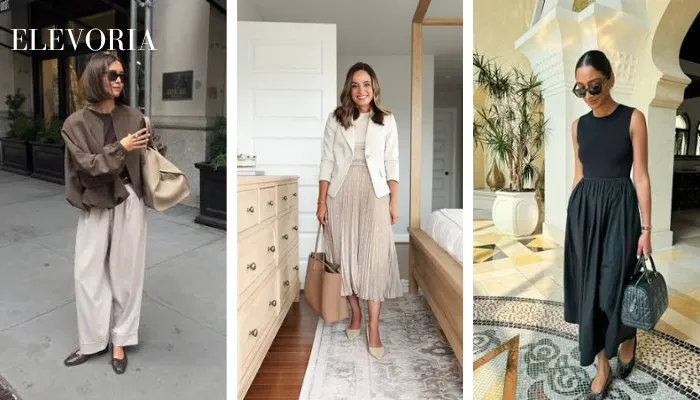
Business casual is the most common dress code in UK workplaces in 2026. It sits one step below business professional and allows for more flexibility while maintaining a polished appearance. Tailored trousers, midi dresses, blazers over knit tops, and polished flats or modest heels are all appropriate.
Smart Casual
Smart casual is the most relaxed professional tier. It works for co-working spaces, creative industries, casual Fridays, and many startup environments. Dark jeans with a structured blazer, a quality knit top with tailored trousers, or a wrap dress with flat shoes all qualify. The line between smart casual and “just casual” is quality of fabric and fit.
The 2026 Reality
In practice, many offices now operate on a spectrum. Davila-Irving notes that most offices are “leaning toward an ‘elevated casual’ vibe”. The key is to read your specific workplace culture and dress one notch above the baseline.
Key Work Outfit Trends for 2026
The 2026 workwear season is defined by several clear trends, from the runways to the high street.
Wide-Leg Trousers
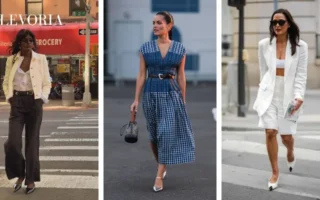
Wide-leg trousers are the defining workwear silhouette of 2026. Vogue describes them as “one of those rare wardrobe staples that truly work for almost everyone, in almost every setting. Roomy and forgiving yet still polished and sleek, wide-leg trousers strike the balance between comfort and sophistication, seamlessly transitioning from office hours to off-duty plans without missing a beat”.
The silhouette spans the price spectrum, from “sharply tailored iterations by Saint Laurent to clean, minimalist options at Cos”. For work, tailored silhouettes work best. Vogue recommends “poplin, drill or a wool-blend, with pleats as a welcome extra”.
The Collarless Blazer
Blazers have sat solidly in workwear wardrobes for decades, but for Spring/Summer 2026 they have had a styling tweak: they have gone sans collar. Marie Claire notes that “the beloved blazer has simply lost its collar for the warmer months”. Look to Chloé, The Row, and Loewe for inspiration. A collarless blazer feels modern and less corporate while still providing structure.
Statement Midi Skirts
Statement midi skirts are leading the charge this season. “The lower the skirt sits on the hip, the better,” notes Marie Claire, citing Tory Burch, Chanel, and Toga as examples. A belt exaggerates this detail. This season, there are leather pencils, croc-effect pencils, printed pencils, denim pencils, and versions with slits, embellishment, and unexpected textures.
The Standout Shirt
The classic white cotton shirt is getting an update. Marie Claire notes that “Chanel, Saint Laurent, and Valentino all make a compelling case for something a little more fun. So why not swap the old classic for big bows and bold colour”.
Utility Touches
“Safari shades are one of the biggest trends of the season—but their umbrella theme of utility is standing just as strong. Think plenty of pockets, zips, and deep green hues; all of which make classic workwear staples feel suddenly much cooler”.
Soft Power Tailoring
“Soft power tailoring is leading the way for 2026. Relaxed suits, wide leg trousers, rounded shoulder blazers and monochrome outfits. It is polished without being rigid,” said Norman Drieselmann, chief executive of Edgars. Warm neutrals such as caramel, oat, stone and soft grey are staples, while “emerald, garnet and sapphire are the standout tones”.
Glove Pumps
After several seasons of loafers, ballet flats, and even sneakers dominating the office, the pump is back. Glove pumps are “defined by their sleek, high-vamp construction, they deliver a second-skin effect that feels equal parts polished and sensual, offering a modern way to top off a look”.
Statement Colour
Burgundy is replacing black as a key autumn shade for workwear. Tracee Ellis Ross demonstrated how to wear summer’s boldest colour pairing to work: “Think a blue shirt, a statement skirt—if red isn’t your top choice, silver, green or a bold print work just as well—and a classic court shoe”. Cobalt blue is another standout shade, described as bold but versatile.
Work Outfit Formulas That Work
Every work outfit can be reduced to a formula. Once you know the formulas that suit your style, dressing becomes a fill-in-the-blank exercise rather than a creative crisis.
The Wide-Leg Trouser and Fitted Top Formula
The most reliable work outfit formula of 2026 pairs wide-leg trousers with a fitted top. This balance of volume and proportion creates a polished, modern silhouette. Vogue recommends pairing grey wool trousers with “a simple white button-down and lightweight black jacket”.
The Blazer and Jeans Formula
Blazers and denim are the easiest work outfit formula to elevate your wardrobe. Marie Claire notes that blazers have “an uncanny ability to make even jeans feel more formal”. For a work-friendly look, style a boxy blazer alongside a slimmer denim silhouette in a darker wash.
The Linen Suit Formula
The linen suit is one of the most elegant solutions to warm-weather work dressing. Glamour recommends “a softly structured blazer paired with straight-leg trousers” which “feels polished enough for meetings, while still allowing for airflow”. Style it with “a simple tank or fine knit underneath, minimal jewellery, and a leather sandal or sleek trainer”.
The Coloured Shirt and Statement Skirt
Tracee Ellis Ross demonstrated this formula for work: “a blue shirt, a statement skirt—if red isn’t your top choice, silver, green or a bold print work just as well—and a classic court shoe”. This combination is “simple in structure yet impactful in shade”.
The Tonal Formula
“If you prefer a neutral palette—gray, cream, camel, et cetera—tonal dressing is an easy formula to follow. Layer a lightweight coat or tailored jacket over a sweater and wool trousers in the same color family”.
Fabrics for Work Outfits
The fabric of your workwear determines how comfortable you will be, how the garment drapes, and how well it lasts.
Breathable Fabrics
Breathable fabrics are essential. “Air passes through and sweat evaporates, so you don’t feel clammy or overheated. They reduce odor buildup and the sticky feeling, especially in warm weather”. Linen, cotton, and wool are the best choices for workwear.
Natural Fibres
Cotton: Breathable, soft, and durable. Cotton poplin is a summer best friend for office wear.
Linen: Naturally cool and moisture-wicking. Linen blends offer breathability with less creasing.
Wool: Warm, breathable, and holds its shape. Merino wool is particularly soft and fine.
Silk: Smooth, breathable, and luxurious. Silk blouses add a touch of elegance to any work outfit.
Stretch Fabrics
Compact stretch fabrics, often a blend of polyester, viscose, and elastane, are used in tailored dresses for comfort and recovery. These fabrics “hold their shape through a full working day” and are “made in fabrics that don’t crease the moment you sit down”.
What to Avoid
Synthetic fabrics that trap heat and moisture should be avoided, particularly in warm offices. Heavy wool, thick denim, and non-breathable blends should be avoided in summer workwear.
Work Outfits for Every Body Type
There is no single “ideal” body type. The goal is to find silhouettes that flatter your shape and make you feel confident, comfortable, and professional.
Hourglass
The hourglass figure has a defined waist with bust and hips of similar size. Wrap dresses, belted blazers, and fitted pencil skirts that follow the waist work beautifully. A-line dresses and fit-and-flare silhouettes also flatter.
Pear
Pear-shaped figures have a smaller bust and shoulders with fuller hips. A-line skirts and dresses balance the silhouette by skimming over the hips. Structured shoulders and statement necklines draw the eye upward.
Apple
Apple-shaped figures have a fuller midsection. Empire waist dresses and flowy midi options are flattering. V-necklines create a break on the upper torso, drawing the eye upward.
Rectangle
Straight, athletic figures can wear a wide range of silhouettes. Belting at the waist creates definition. Peplum details, ruffles, and wrap styles add curves.
Petite
Petite frames look strongest in column or sheath silhouettes, which lengthen the line. A high-waisted wide-leg trouser with a fitted top can also work beautifully.
Plus Size
Plus-size figures look strongest in pieces cut to actual measurements rather than scaled-up patterns. Eloquii is recommended for “statement suits” in “every shape, color, and print”. Universal Standard offers “structured blazers, ponte trousers, and wrap dresses” as reliable choices.
Sizing varies by brand, country, and manufacturer. Always check the specific brand’s size chart rather than assuming your usual size will fit.
Plus Size Work Outfits
The plus size workwear market has expanded significantly, with more options than ever for flattering, stylish professional attire.
Key UK Retailers
Eloquii is recommended for “stylish suiting” in plus sizes, with “classic suits” and “of-the-moment takes”.
Universal Standard offers “The 6 Workwear Essentials” including “The Structured Blazer — Lennox Collarless Ponte Blazer,” “The Button-Down Blouse — Elbe Stretch Poplin Shirt,” and “The Knit Top — Lily Liquid Jersey V-Neck”.
Roman UK offers “women’s work trousers & coats” and “smart casual workwear for women” designed for “boardroom meetings to casual Fridays”.
Simply Be offers “office dresses in sizes 10-32,” with “lightweight summer work dresses” designed for “a flattering fit, ultimate comfort and impeccable style”.
Body-Inclusive Styling
The goal is not to conceal but to feel confident. A well-fitted outfit in a flattering silhouette will always look better than a shapeless one. Sizing varies by brand. Always check the specific brand’s size chart and read reviews for fit guidance.
Sustainable Work Outfits
Sustainability is increasingly important in fashion, and workwear is no exception. There are more lower-impact options than ever for building a professional wardrobe.
Sustainable Fabrics
Organic Cotton: Grown without harmful chemicals. Craghoppers’ Wakefield Pocket Workwear T-shirt is made from “organic cotton Jersey or marl organic cotton-rich Jersey” and is “sun-protective and anti-odour for hot working conditions”.
Tencel Lyocell: A sustainable fibre made from wood pulp in a closed-loop process. Soft, breathable, and moisture-wicking.
Recycled Materials: Damson Madder has teamed with Amsterdam-based AMK Atelier for its first workwear denim capsule collection. “The entire collection is made with organic cotton and durable hardware trims and produced in Turkey in limited quantities, keeping both quality and intention at the core of the process”.
Sustainable Brands
Damson Madder offers the Julia Worker Jacket, Lisa Dungarees, and other workwear pieces made from organic cotton.
Finisterre offers hemp and organic cotton blend short dungarees, made from a “soft and breathable blend of hemp and organic cotton” and inspired by “utility workwear”.
The Textile Exchange provides certification and guidance on preferred fibres, including organic cotton, recycled materials, and other lower-impact alternatives.
How to Build a Work Capsule Wardrobe
A capsule wardrobe is a curated collection of versatile pieces that can be mixed and matched to create multiple outfits. For workwear, this approach saves time, money, and decision fatigue.
The Essential Categories
Jackets and Blazers: A structured blazer anchors the workplace wardrobe. It can make even jeans feel more formal. Look for a well-fitted blazer in a neutral colour that works with multiple outfits. The collarless blazer is a modern alternative.
Work Pants: Tailored trousers in wide-leg, straight-leg, or balloon silhouettes are essential. Wide-leg trousers are particularly on-trend for 2026.
Blouses and Shirts: Polished blouses and no-iron shirts form the backbone of a work wardrobe. Look for cotton poplin, silk, or viscose blends.
Skirts and Dresses: Midi skirts, pencil skirts, and work dresses create easy professional outfits. A structured midi dress or a shirt dress is a complete outfit in one piece.
Knitwear: Fine-knit tops, cardigans, and lightweight jumpers provide warmth and layering options.
Shoes: Glove pumps, loafers, ballet flats, and sleek sneakers are all appropriate depending on your office dress code.
Outerwear: A trench coat, tailored wool coat, or structured jacket completes the professional look.
The 12-Piece Capsule
A well-constructed 12-piece capsule can create a full week of outfit combinations. The formula typically includes: 2 blazers or jackets, 2 pairs of tailored trousers, 1 skirt, 2-3 blouses or shirts, 1-2 dresses, 1-2 knitwear pieces, 1 pair of shoes, and 1 bag.
Where to Shop for Work Outfits in the UK
High Street and Department Stores
Marks & Spencer offers tailored trousers, waist-defining blazers, and structured midi dresses. The Autograph range is particularly strong for workwear basics.
Reiss is described as “my number-one recommendation for high street workwear. Reiss occupies that sweet spot between high street and designer — the tailoring is excellent, the fabrics are considered, and the cut is consistently flattering”.
COS is “consistently excellent” for “the more contemporary, minimal wardrobe. Their tailored trousers and structured shirts are sleek, understated, and built to last”.
Hobbs offers “timeless, tailored, and thoroughly British. They’re particularly strong on smart dresses and co-ord suiting”.
Me&Em makes “beautifully considered workwear basics: good trousers, smart knits, tidy shirts in proper fabrics”.
Karen Millen offers “structured silhouettes and flowing fabrics that will bolster your workwear wardrobe, all for an affordable price,” with prices ranging from £79 to £399.
Next delivers stylish workwear at accessible prices, including breezy midi dresses and tailored separates.
Roman UK offers “women’s work trousers & coats” and “smart casual workwear for women” designed for “boardroom meetings to casual Fridays”.
Budget Options
Primark offers affordable workwear staples. H&M is “another reliable option” for budget-friendly tailoring. Uniqlo has partnered with Smart Works for “The Power of Clothing” workwear edit, with “a focus on building blocks – the wide-leg trousers you reach for on repeat, knowing they’ll work”.
Online and International
ASOS offers a broad range of workwear across mainline, Curve, Petite, and Tall. Net-a-Porter offers elevated workwear, including tailored separates and beautifully cut suits.
Expert Styling Tips
Start Classic, Then Twist
Kat from Finance, who documents her directional workwear on social media, offers this advice: “Start with something classic – sharp tailoring, clean lines – and then twist it. Add an unexpected texture or a bold accessory. The aim is always balance – you want to feel powerful without looking like you’re in costume. For me, style at work is about control and intention. It doesn’t have to scream to say something”.
Play With Volume and Contrast
“I’m a big believer in playing with volume and contrast. If the bottom half is wide and oversized, I’ll keep the top more fitted – or the other way around. I’m also conscious of how pieces sit on the body: where a hem lands, how a sleeve drapes, the length of a jacket. Belts form an integral part of my looks too – especially when I want to bring shape back into something more architectural”.
Keep It Simple
You can “never go wrong with a well-cut white shirt”. For a polished but relaxed look, the French tuck (tucking the front of your top into your bottoms and letting the back fall loose) defines the waist without looking overly styled.
Common Mistakes to Avoid
Mistake 1: Ignoring the Dress Code
Business professional and business casual are not the same. Wearing business casual clothing in a business professional context is a common failure mode.
Mistake 2: Prioritising Style Over Comfort
If you cannot sit, walk, or work comfortably in an outfit, you will not be at your best. Comfort and credibility are not mutually exclusive.
Mistake 3: Buying Too Many Trend Pieces
Trends are useful for updating a wardrobe, but a work wardrobe should be built on timeless staples. Invest in quality basics first.
Mistake 4: Neglecting Fabric Quality
Cheap synthetic fabrics can look tired quickly and feel uncomfortable. Natural fibres and quality blends last longer and look better.
Mistake 5: Not Checking the Size Chart
Sizing varies significantly between brands. Always check the specific brand’s size chart rather than assuming your usual size will fit.
Mistake 6: Over-Accessorising
A polished work outfit does not need statement jewellery. Choose one or two refined pieces and let the tailoring speak.
Actionable Recommendations
- Decode your office dress code first. Understand whether your workplace is business professional, business casual, or smart casual. Dress one notch above the baseline.
- Build a capsule wardrobe. Invest in versatile staples: a structured blazer, tailored trousers, quality blouses, and a midi dress. A 12-piece capsule can create a full week of outfits.
- Choose natural fabrics. Cotton, linen, wool, and silk are breathable, comfortable, and look more premium than synthetics.
- Invest in the right shoes. Glove pumps, loafers, and ballet flats are all appropriate. Choose comfort alongside style.
- Update with one trend per season. Add a statement shirt, a pair of wide-leg trousers, or a collarless blazer to refresh your look without overhauling your wardrobe.
- Check the size chart. Sizing varies by brand. Always check the specific size guide and read reviews for fit advice.
- Care for your workwear properly. Wash less often, use cold water, turn garments inside out, and store properly.
- Consider sustainable options. Organic cotton, Tencel, and recycled materials are increasingly available in workwear.
Frequently Asked Questions
What are the key work outfit trends for women in 2026?
Key trends include wide-leg trousers, collarless blazers, statement midi skirts, standout shirts, utility touches, soft power tailoring, glove pumps, and statement colours like burgundy and cobalt blue.
What is the difference between business professional and business casual?
Business professional is more formal, requiring tailored suits, structured blazers, and classic court shoes. Business casual is more relaxed, allowing tailored separates, structured knitwear, smart trousers, loafers, and clean trainers.
What should I wear to work in a business casual office?
Tailored separates, structured knitwear, smart trousers or well-cut dark jeans, loafers, and clean trainers. The key distinction from true casual is intention. Everything should look deliberate, not thrown together.
Where can I buy work outfits for women in the UK?
M&S, Reiss, Me&Em, Hobbs, COS, Massimo Dutti, Karen Millen, Next, and Roman UK are all reliable options. Budget options include Primark, H&M, and Uniqlo. ASOS and Net-a-Porter offer online options.
What fabrics are best for workwear?
Natural fibres like cotton, linen, wool, and silk are breathable and look premium. Viscose, modal, and Tencel are soft and drape beautifully. Avoid heavy, stiff fabrics and thin, clingy synthetics.
Where can I buy plus size work outfits in the UK?
Eloquii, Universal Standard, Roman UK, and Simply Be offer plus size workwear. Eloquii is recommended for “stylish suiting” and Universal Standard offers a six-piece workwear essentials collection.
What are sustainable options for work outfits?
Look for organic cotton, Tencel Lyocell, and recycled materials. Damson Madder offers a workwear denim capsule made with organic cotton. Finisterre offers hemp and organic cotton blend dungarees.
How do I build a capsule work wardrobe?
Invest in versatile staples: a structured blazer, tailored trousers, quality blouses, a midi dress, and appropriate shoes. A 12-piece capsule can create a full week of outfit combinations.
What shoes should I wear to the office?
Glove pumps, loafers, ballet flats, and sleek sneakers are all appropriate depending on your office dress code. The glove pump is a key trend for 2026. Choose comfort alongside style.
How should I style a wide-leg trouser for work?
Pair wide-leg trousers with a fitted top to balance proportions. Vogue recommends “a simple white button-down and lightweight black jacket” for grey wool trousers. For a more casual look, pair with a knit polo and loafers.
Conclusion
Work outfits in 2026 are defined by a balance of polish and personality. The rigid rules of the past have given way to a more personal, comfortable approach to professional dressing, but the fundamentals remain: quality fabrics, good fit, and a wardrobe built on versatile staples.
From the return of the glove pump and the statement midi skirt to the rise of the collarless blazer and soft power tailoring, the trends of 2026 offer plenty of ways to refresh your work wardrobe without abandoning the classics. Whether your office is business professional, business casual, or smart casual, the key is to understand the dress code, invest in quality pieces that fit well and feel comfortable, and build a capsule wardrobe that makes getting dressed each morning effortless.
The most important takeaway is this: the best work outfits are the ones that make you feel ready for whatever the day brings, whether that is a boardroom presentation, a client meeting, or a full day at your desk. Trends provide inspiration, but personal style and comfort are enduring. Use this guide as a starting point, then make it your own.
Read More: A-Line Dresses 2026: Complete Guide to Styles & Sizing